
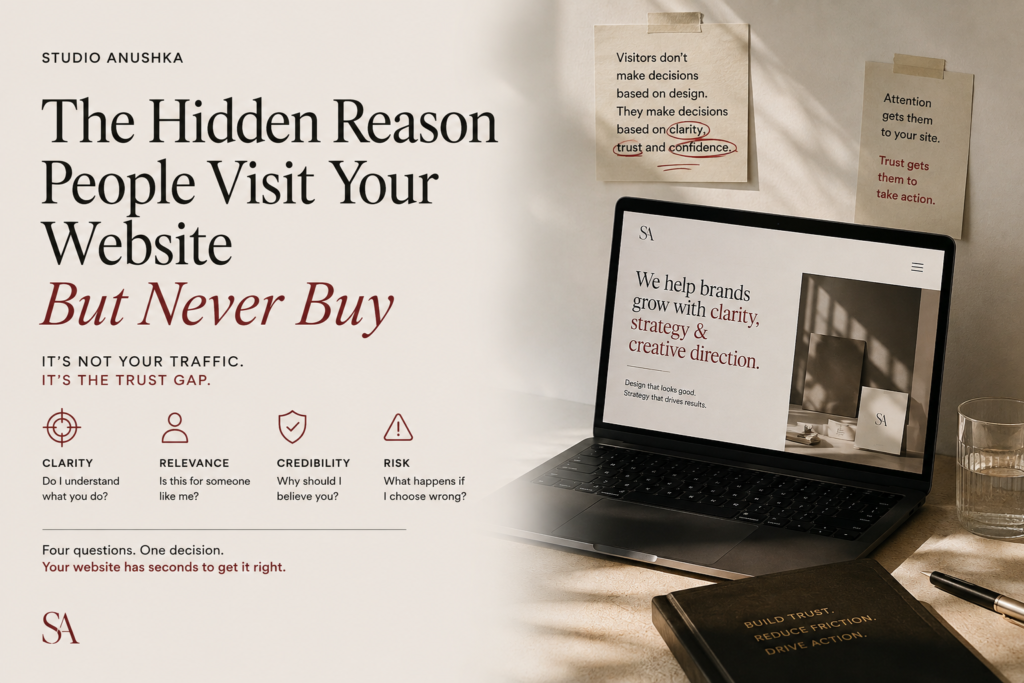
Most business owners believe they have a traffic problem.
They check their analytics, see visitors coming in, and quickly think the answer is more marketing, more social media posts, more Google Ads, more content, more reach.
But after looking at many business websites, I’ve noticed a different trend.
Many websites don’t actually have a traffic problem.
They have a trust gap.
People are visiting and showing interest by clicking. They’re spending time on the page. Yet they’re leaving without booking a call, making a purchase, or filling out a form.
The real question isn’t, “How do I get more people to my website?”
It’s, “Why aren’t the people who are already here taking action?”
And that’s where things get interesting.
The Decision Happens Faster Than You Think
When someone arrives at your website, they aren’t carefully reading every word.
They’re scanning.
In just a few seconds, they’re trying to answer a few simple questions:
- Am I in the right place?
- Is this relevant to me?
- Can this business solve my problem?
- Do I trust them enough to take the next step?
Most websites expect visitors to patiently explore and figure things out on their own.
They won’t.
Online, confusion costs you.
The moment someone has to work too hard to understand what you do, they leave.
Not because they aren’t interested.
Because another tab is just one click away.
The Four Factors That Influence Every Buying Decision
Over time, I’ve found that most conversion issues stem from four areas: clarity, relevance, credibility, and risk.
Think of these as the four questions every visitor subconsciously asks before deciding whether to trust your business.
1. Clarity: Do I Understand What You Do?
This may seem obvious, but it’s one of the most common problems.
Many businesses know their industry so well that they accidentally use language that makes sense to them but not to their customers.
Consider a headline like:
“Delivering innovative solutions for modern businesses.”
It sounds professional.
It also tells the visitor almost nothing.
What kind of solutions?
For whom?
What outcome can I expect?
Now compare it with:
“We help service-based businesses turn more website visitors into qualified leads.”
Suddenly, it’s clear.
Visitors shouldn’t have to decode your message. The quicker they understand what you do, the more likely they are to stay.
2. Relevance: Is This For Someone Like Me?
Even if visitors comprehend your offer, they still need to feel it’s relevant to their situation.
Many businesses make the mistake of trying to appeal to everyone.
The broader your message becomes, the weaker it feels.
Imagine you’re the founder of a growing e-commerce brand.
Would you trust a website that says:
“We help businesses grow.”
Or one that says:
“We help e-commerce brands increase conversions through strategy and performance marketing.”
Being specific builds connection.
People trust businesses that understand their challenges, goals, and context.
When a visitor feels understood, they start to pay attention.
3. Credibility: Why Should I Believe You?
This is where many websites lose potential customers.
They make promises but offer very little evidence.
Anyone can claim they’re the best.
Anyone can say they deliver results.
The real question is whether your website gives visitors a reason to believe those claims.
Credibility can come from many sources:
- Case studies
- Testimonials
- Client results
- Industry experience
- Strategic insights
- Clear explanations of your process
Interestingly, credibility isn’t just built through social proof.
It also comes from the quality of your thinking.
When someone reads an article, sees a well-supported opinion, or learns something valuable from your content, they start to see you as an expert.
That’s one reason content marketing remains powerful.
Knowledge builds trust even before a sales conversation begins.
4. Risk: What Happens If I Choose Wrong?
This is the factor most businesses miss.
Buying always involves uncertainty.
Whether someone is buying a product, hiring an agency, or booking a consultation, they’re asking themselves:
“What if this doesn’t work?”
Your website needs to lower that uncertainty.
You can do this through transparency, clear expectations, examples of past work, FAQs, testimonials, guarantees where applicable, or simply explaining what the customer can expect at each phase.
People rarely buy when they’re uncertain.
They buy when they feel confident in their decision.
Why Beautiful Websites Still Fail
One of the biggest misconceptions in business is that a better-looking website automatically leads to better results.
Good design definitely matters.
But design is a tool, not the strategy itself.
I’ve seen visually appealing websites struggle to generate leads because the messaging was unclear.
I’ve also seen simpler websites outperform competitors because they communicated value well.
The goal isn’t to impress visitors.
The goal is to help them make a decision.
A website that looks great but confuses visitors will always lose to a website that communicates clearly.
The Real Job of Your Website
Many businesses treat their website like a digital brochure.
In reality, it should act more like a salesperson.
A good salesperson doesn’t overwhelm people with information.
They understand the customer’s problem.
They explain the solution.
They build confidence.
They guide the next step.
Your website should do the same.
Every headline, section, testimonial, image, and call-to-action should work together to answer one question:
“Why should this visitor choose us?”
If that answer isn’t clear right away, conversions will suffer.
Before You Spend More on Marketing
Before you raise your advertising budget or add more content, take a moment to view your website through the eyes of a first-time visitor.
Can they quickly understand what you do?
Do they feel your offer is relevant to them?
Have you given them a reason to trust you?
Have you minimized the risk of taking action?
If not, more traffic won’t solve the issue.
You will just be sending more people into the same experience.
Growth doesn’t happen when people visit your website.
Growth occurs when visitors trust what they see enough to take the next step.
And often, that’s the hidden reason they’re not buying.