
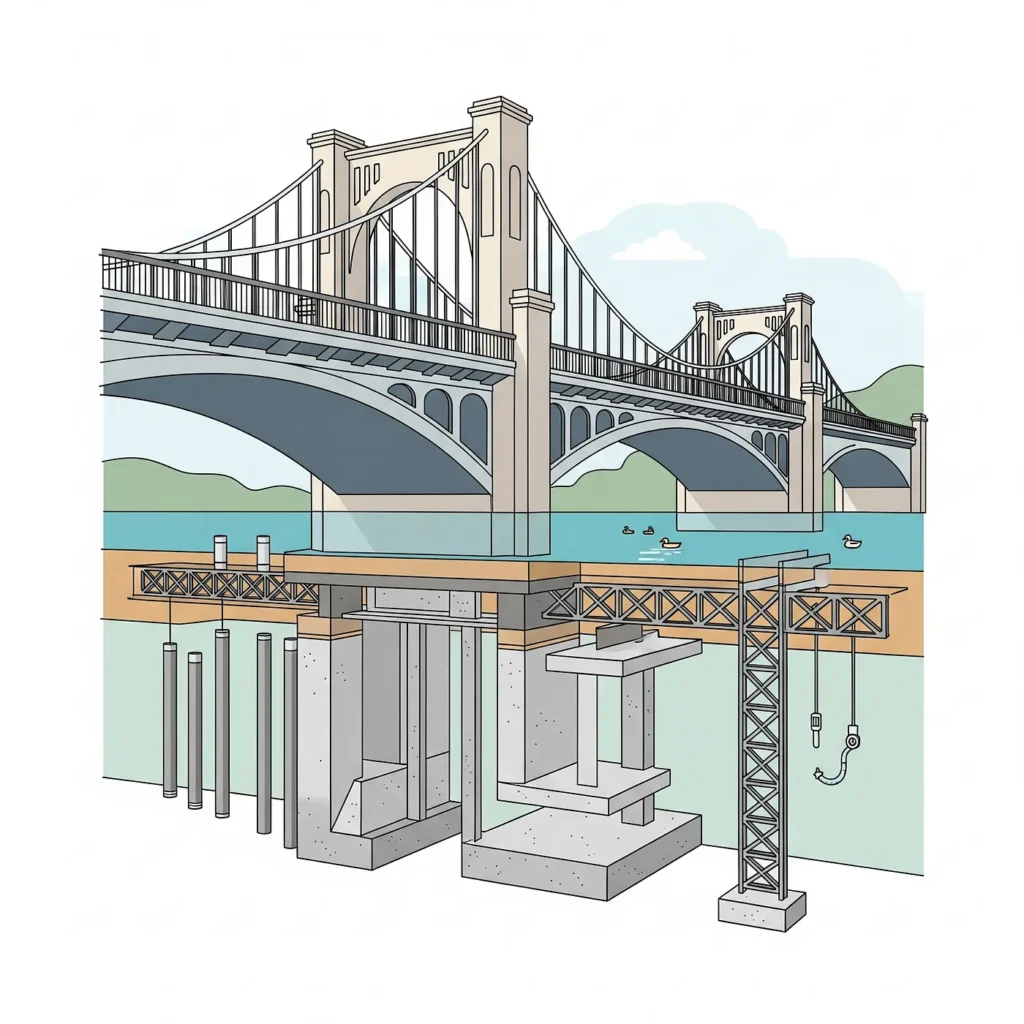
Design isn’t just what we see — it’s the system, structure, and thought beneath it.
(Image: Conceptual illustration of a bridge and its foundation)
The Value of Design Beyond Visual Appeal
Before I truly began to understand design — beyond being just a consumer or someone who appreciated its beauty — I saw it as a tool to make visuals, products, or everyday objects look “pretty.” To me, it was simply a way of turning ideas into attractive visual symbols.
Looking back, that understanding was maybe 1% of what design really is.
Design is often misunderstood and oversimplified, reduced to a few buzzwords or surface-level impressions. But after spending the last five years immersed in this field, I’ve discovered that design is one of the rare disciplines where creativity meets strategic impact. It’s not just about form — it’s about function, behaviour, systems, and change.
Whether it’s shaping mindsets, meeting business goals, or simplifying complex systems, design has the ability to embed itself everywhere. It can craft, question, and communicate ideas in a way that reaches countless people — clearly, powerfully, and often without a single word.
Design Influences Us — Even When We Don’t Notice
Design quietly shapes our choices every day. When we read a magazine, it’s the layout that guides our eyes. Colour evokes emotion, whitespace creates focus, and typography sets a tone — formal, bold, playful — often before we even realise it.
This silent guidance is incredibly powerful. When used thoughtfully, design can influence how we feel, what we notice, and how we act — all without demanding our attention.
As a designer, I’ve become increasingly aware of how even the simplest things — a product label, an ad hoarding, or a website layout — are designed not just to be visually appealing, but to steer behaviour. Think of the iconic red of Coca-Cola — it’s not just branding; it’s a visual trigger tied to emotion, familiarity, and tradition.
Design is everywhere, and while it’s a specialized craft, its effects are universal. I encourage you to pause the next time you see a well-designed object or space — ask yourself what it made you feel or do. There’s insight in that.
Design and the Challenges of Our Time
We’re living through an era of uncertainty — from climate change and AI disruption to global inequality and economic shifts. These large, complex problems force us to ask: Where do we stand? What can we do?
In this context, I see design as a source of hope — and a practical tool for progress.
Recently, I came across a sustainable innovation by the Warka Water project: a low-tech structure that can harvest up to 1,000 litres of clean drinking water from air each day in off-grid communities. This solution isn’t just ingenious — it’s sustainable, low-cost, and life-changing.
What struck me most was that this wasn’t traditionally seen as a “design” solution. Yet it is. It redefines what design can do: solve real, human problems in unexpected, powerful ways.
Design is no longer just about objects or interfaces. It’s about systems, behaviours, ethics, and futures. And the more challenges the world faces, the more design will matter.
Let’s Talk
Thanks for reading!
Do you believe design could be the next big force driving global change — or has it already been that all along?
Let’s start a conversation.